


About us
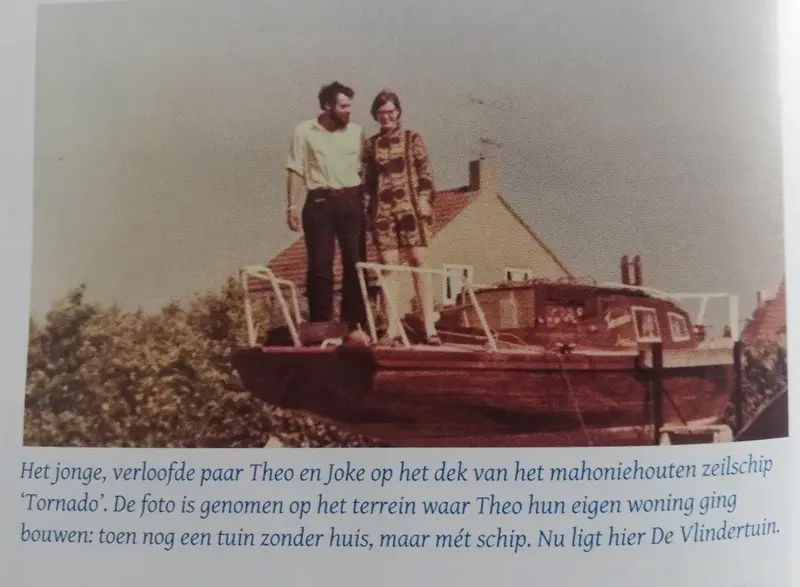
Out of love for nature, Theo and Joke named this place: De Vlindertuin.
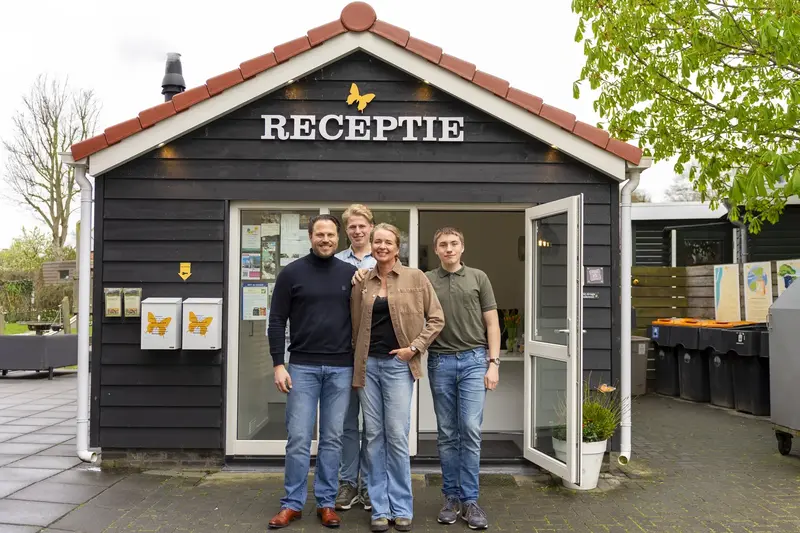
Theo and Joke Mosterman started the guesthouse in 1971 and over the years built the business into the friendly apartment complex it is today. Since 2018 we, Michiel and Froukje Mosterman, have been proud co-owners of De Vlindertuin. Michiel is the youngest son of Theo and Joke. Grandsons Hidde and Jelle can often be found in the De Vlindertuin playground too. The day-to-day management of the apartments is in the hands of the Mosterman family.
Our aim is to give you a wonderful holiday on Ameland by bringing the island's beautiful nature to the apartments, and in doing so to contribute to further improving the ecology of the Wadden area. We pursue our ambition to promote sustainability on the island by “greening” the building and the surroundings of the complex in various ways over the coming years.
Below is the article that appeared in De Amelander. It was written by Marieke Robijn-Voorn.
The metamorphosis of De Vlindertuin: a sustainable stay in Nes
On a sunny Saturday I report to the brand-new reception of De Vlindertuin in Nes. The owners of the apartment complex, Michiel and Froukje Mosterman, give me a beaming welcome. A few years ago they took over the family business. Full of passion, they are working together on its future. The complex has existed for forty years: the first foundations were laid by Michiel's parents. In the early seventies, Theo Mosterman built a house with his own hands for his wife Joke and their young family, where guests could stay as well. Over the years he expanded it further: from a guesthouse at home to a complete apartment complex. Out of love for nature, Theo and Joke named this place: De Vlindertuin. The friendly complex lies just outside the centre of Nes, in the little neighbourhood behind the Kardinaal de Jongweg.
‘De Vlindertuin already existed when I was born,’ Michiel muses, showing me the spot where his cradle once stood. ‘With me as a baby in her arms, my mother Joke looked after the guests.’ Michiel grew up in the family business, just like his older brother and sister. For secondary school he left for Leeuwarden, where he met Froukje. It was love at first sight. During school holidays and weekends the young couple always went to Ameland, to Michiel's parents. ‘As a teenager I was already folding linen here together with Joke,’ says Froukje. It is clearly a cherished childhood memory. And now their sons Hidde and Jelle lend a hand at De Vlindertuin. ‘We want guests to have a lovely, carefree time here,’ she continues. ‘That already starts on the boat, when you don't have to bring a lot of things. And you can leave the car in Holwerd.’ You see this care everywhere in De Vlindertuin. On the terrace you'll find gleaming barbecues, chests full of toys and beach gear are ready for the children, guests can wash and dry for free - and of course make use of the sharing cupboards for groceries, kitchen supplies and books. I soon discover that these facilities are only the beginning of what care means at De Vlindertuin.
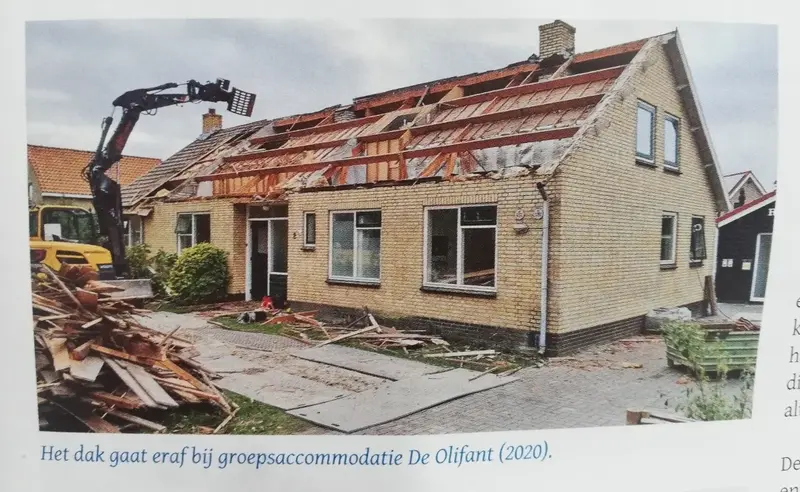
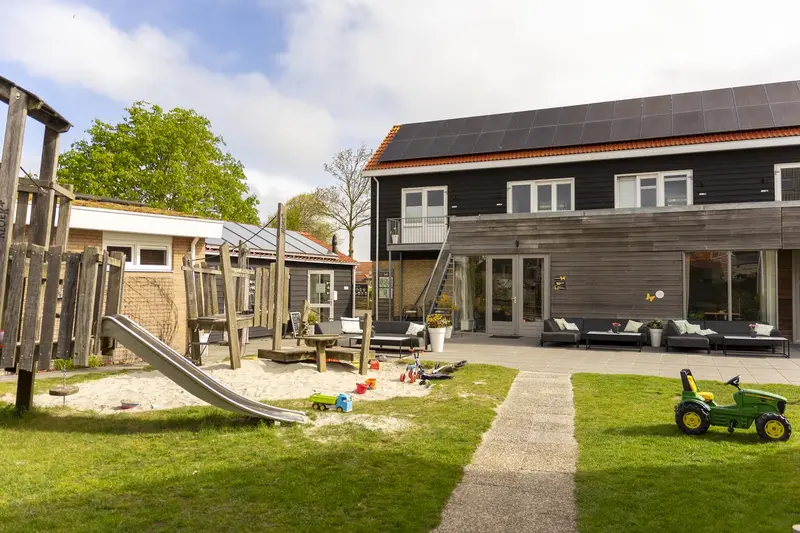
Michiel and Froukje tell me their story in the breakfast room of the apartment complex. The atmospheric, contemporary space opened just this spring. The place where we are sitting has been completely renovated. It used to be a group accommodation, De Olifant. The Mosterman family was able to take it over from the neighbours. With this extension, De Vlindertuin gained a new entrance on the corner of the Kardinaal de Jongweg and the Polderweg. The old Olifant was rebuilt from the ground up. ‘Last year the old roof came off,’ says Michiel. ‘Everything was open, and then it rained for days! It looked like a swimming pool…’ Now he can laugh about it, relieved that it all ended well. The walls with the characteristic light brick have been preserved. The original sloping roof has also returned in the design, so that the whole fits nicely into the streetscape. ‘Returning guests still recognise the building from the old days. Recently an older man came up to me: this is where I kissed my girl for the first time as a young man!’ Next to and above the breakfast room, Michiel and Froukje have had a number of spacious apartments built. De Vlindertuin has now literally come ‘full circle’. Those seeking peace and quiet can head to the back of the complex, while families often choose an apartment on the inner garden with a cosy terrace and a wooden climbing area for the little ones. The view will gain extra colour in the coming period: the first sedum roof with bright succulents has been laid, and more will follow soon.
The green sedum roof brings our conversation round to sustainability and nature. Michiel has loved Ameland and the Wadden Sea since he was a child. His parents Theo and Joke organised boat trips on the Wadden Sea to introduce people to this unique natural area. ‘The seal-spotting boat M.S. Ameland is still part of the family business,’ says Michiel. ‘My older brother Arjen is now at the helm. After a few years sailing the world's oceans, he too chose the life of a Wadden skipper, just like our father.’ Theo was still there for the last expansion of De Vlindertuin; not long afterwards he passed away. ‘I would so love for him to see how it has turned out,’ Froukje says thoughtfully. ‘To ask him what he thinks of the renovation, to hear his headstrong opinion…’ Theo did see the design of the new logo. Michiel and Froukje designed it themselves: it symbolises Ameland and the lighthouse – with a butterfly, of course. ‘We couldn't decide which colour to choose for the little butterfly, so we asked Michiel's parents. Theo picked this cheerful orange-yellow colour! It radiates joy of life and vitality, enthusiasm and energy. Just like he did himself.’ Joke is still warmly involved in De Vlindertuin. She helps out where needed, does a breakfast shift or welcomes guests. ‘To everyone's delight: many regular guests have known Joke for decades.’
During the week, Michiel and Froukje live and work in Leeuwarden. At weekends they are on Ameland and spend their free time on De Vlindertuin. Every Friday morning they take the boat over, and on Sunday evening the family heads back to the mainland. It sounds like a demanding combination to me: two jobs, two children and a business of their own. ‘It certainly is!’ laughs Froukje. ‘During the week we manage De Vlindertuin from Leeuwarden. We prepare a digital overview of the tasks for the team, and we're always available for questions. That works well, thanks to our independent staff. Although of course we do send a lot of WhatsApp messages!’ For Michiel and Froukje, running a business on Ameland is an inspiration for their jobs on the mainland – and vice versa. ‘During the week I work as a lecturer at the university of applied sciences in Leeuwarden,’ says Froukje. She is a senior lecturer on the Business Administration & Agribusiness programme and teaches, among other things, corporate social responsibility. ‘At the university we want to train young professionals who contribute to a better world. We can call ourselves the most sustainable programme in the Netherlands.’ Froukje describes enthusiastically how the students hang on her every word on Monday mornings when she shares her experiences as an entrepreneur with them. ‘Here at De Vlindertuin I put theory into practice: that way you really have something to tell your students.’
Michiel also works on a sustainable future during the week: at GroenLeven. He develops solar parks all over the Netherlands. ‘That can be anywhere: on greenhouses, industrial estates or landfill sites... These places become more valuable by generating clean energy.’ Naturally, Michiel has also fitted De Vlindertuin with solar panels. ‘For me this really is a test garden: how can I best use solar energy for the comfort of our guests?’ And with success: since this year the apartment complex offers a climate-neutral stay on Ameland. There are more than 100 solar panels on the roofs, covering the energy consumption. Solar thermal collectors and buffer tanks have been installed for hot water and heating. Thousands of litres of water, heated by the sun, are ready for use every day. For the remaining heat demand, on cold cloudy days, De Vlindertuin uses forest-offset gas. There are also charging points for electric cars and e-bikes on site. ‘All on solar power! We have more solar panels here than beds…’ Michiel honestly admits that he sometimes gave the installers a headache. ‘I know exactly how I want it, but I can't do it myself. Behind the scenes, the Ameland installation company Oud has already pulled off several small masterpieces here.’
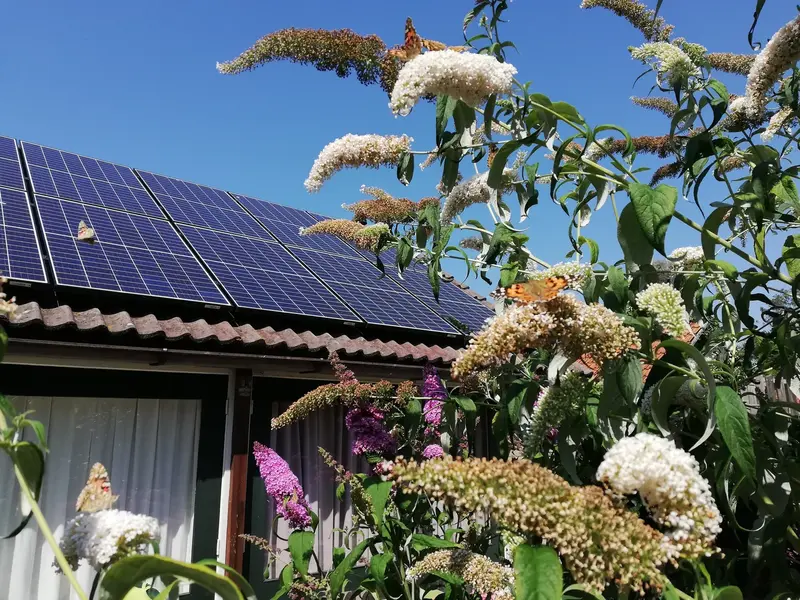
Enjoying nature naturally: that is what De Vlindertuin stands for.
- Froukje Mosterman
‘Striving for sustainability is close to both our hearts,’ says Froukje. When she and Michiel took over De Vlindertuin, they set out four lines for the future. Generating clean energy comes first. The second line is about biodiversity. As a Wadden island, Ameland has a unique ecology, yet it faces the same challenges as the mainland. ‘Pollinating insects such as butterflies and bees are essential for agriculture and nature. We can all do something to prevent insect numbers from declining further. In the inner garden we have sown native flowers, planted a number of fruit trees, berry bushes and herbs, and hung up a series of bee hotels. And of course dozens of butterfly plants, which do justice to the name of the complex.’ Nature is a lot of work, as every gardener knows. ‘We had specially scattered native flower seed, and the pigeons ate it all…’ There is something here for everyone to learn: educational signs can be found on the walls, workshops are organised during the Butterfly Count weeks, and the caretaker of De Vlindertuin is a biologist, always happy to tell you something about nature. Guests who enjoy it can join in the gardening or simply pick some herbs, vegetables and fruit for their meal. That Michiel and Froukje are serious about this is clear from their participation in the Dutch-German project Silence of the bees. ‘In a covenant we have made concrete agreements on what we will contribute to the bee population over the next two years.’
A third line is about human wellbeing. ‘Take good care of yourself and of nature,’ says Froukje. ‘Enjoying nature naturally: that is what De Vlindertuin stands for.’ This line, too, was already started by Michiel's parents. His mother Joke began with a meditation room in the attic and now teaches the Chinese movement practice Qigong. Michiel and Froukje have opened WellNES: a small practice right next to the new entrance, with a wide range of treatments. ‘It is so lovely that the practice can open its doors! Young and old can come here for a relaxing massage. We work together with various Ameland businesswomen, so there is a suitable treatment for everyone. At the moment these are the masseurs of NaturEl and Ontmoet Hart & Ziel.’ WellNES can also be the starting point of an inspiring coaching session, on site or during a walk through the wide-open countryside. Especially for guests, a sauna has been placed in the inner garden, with a refreshing outdoor shower. ‘Swimwear required!’ laughs Michiel. ‘We consider attention to wellbeing important for our guests as well as our staff,’ Froukje continues. At university of applied sciences, human resource management is one of the subjects she teaches. ‘We offer employees a balanced set of tasks, so the work does not become monotonous or burdensome and you actually get energy from it. Do you have a hospitable, green heart and are you looking for independent work that suits you? You are always welcome at De Vlindertuin.’
The fourth and final line that Michiel and Froukje have mapped out is about the local and circular economy. ‘Can that broken vacuum cleaner be repaired? Then we do that, at a business on Ameland. And the mountains of laundry don't go to the mainland for the lowest price; we have them cleaned here on the island.’ In the breakfast room they point out examples of reuse to me that I would otherwise not have recognised. A sturdy wooden table turns out to be made from old stair treads, and the kitchen dresser used to be the bar on one of Theo and Joke's ships. The trendy black corner benches turn out to be vintage too: Michiel's parents bought them for their first guests. In these choices, comfort always comes first. For example, Michiel and Froukje have bought luxurious new beds for all the apartments. ‘We first bought a hotel bed ourselves, to sleep on for a while. One… and another one… In the end, after four beds, we settled on Swiss Sense, a Dutch family business.’ I am already impressed by this dedicated market research, but the story goes further. ‘The combination with a generous topper mattress, that was what we found slept best. But it turned out that with that combination the bed became too high. And that is not pleasant for children and older people. Shorter legs under the box spring: not an option, because then you can no longer vacuum under the bed. What to do?’ In consultation with the manufacturer, new box springs were developed especially for De Vlindertuin. ‘At the right height for our guests and our staff!’ I am allowed to stay one night to experience it for myself. I usually don't sleep well straight away in an unfamiliar bed, but this time… like a log.
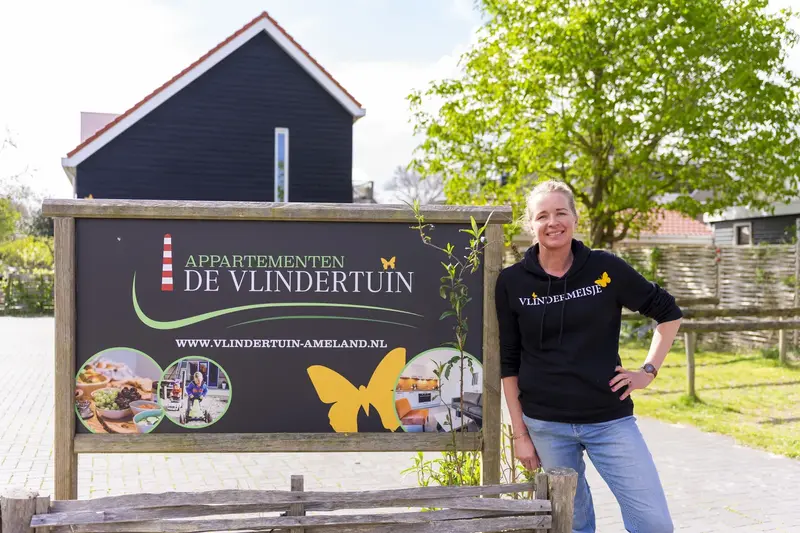
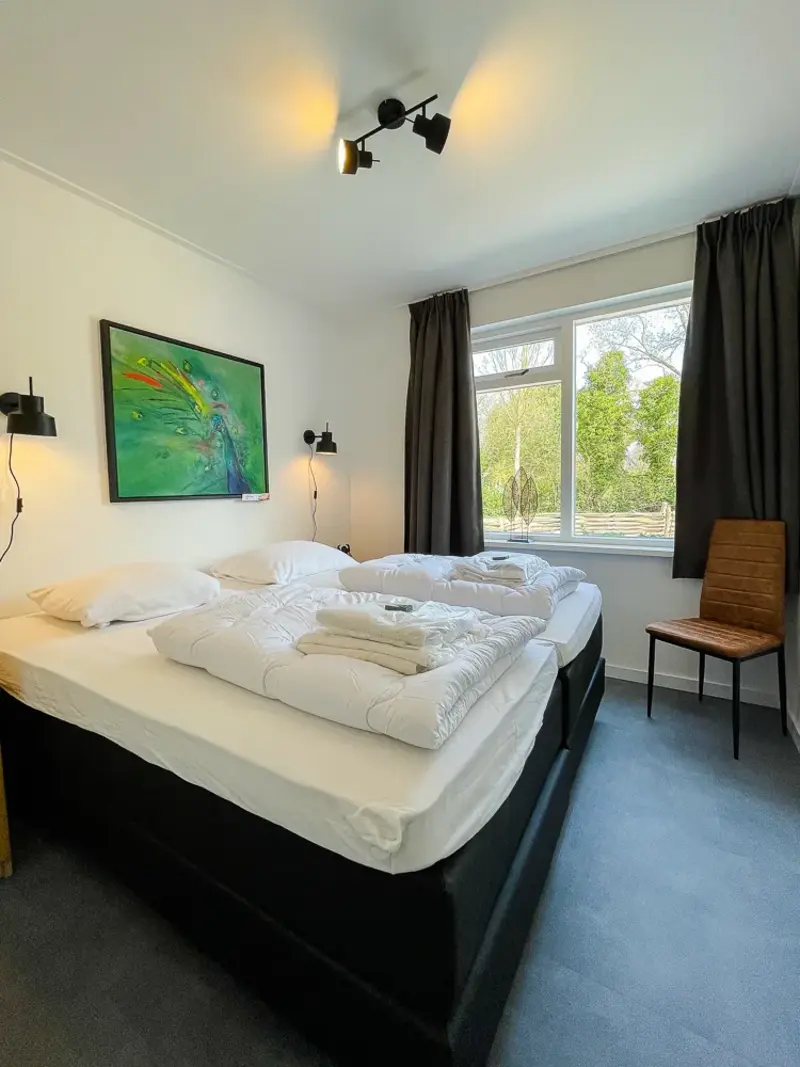
We have more solar panels here than beds…
- Michiel Mosterman
The next morning I first enjoy the well-presented breakfast buffet. It's allowed again! On the wall of the breakfast room hang colourful photos of the island's nature, by expert and photographer Theo Kiewiet. He has a regular column in the magazine De Amelander: it's wonderful to be able to see his work here in large format. After breakfast I walk through the friendly inner garden, looking for Joke. Since Theo passed away, she has lived in a small studio on the complex. At weekends she looks after her grandsons Hidde and Jelle while Michiel and Froukje are at work. ‘"Would you like to live here?" was one of the first things Theo asked me when we met,’ Joke tells me with a smile. Theo was a born-and-bred Amelander; she herself grew up in …. ‘I had only seen the sea a few times!’ Joke was in her early twenties and worked as a paediatric nurse in the hospital. She had travelled to Ameland with a friend for a few days' holiday. A sister of her friend picked them up from the boat: she was married to an Amelander, a Mosterman, and lived in Nes. First they went to say hello to the in-laws. Joke and her friend were introduced and had just been given a cup of tea when a handsome, dark young man came storming into the room. ‘He was telling enthusiastically about his adventures on the mudflats and was so absorbed in his story that he didn't even notice us.’ Joke had just shaken hands with a number of blond Mostermans - she couldn't immediately place this boy with his dark hair and twinkling brown eyes. "Is he one of yours too?" I asked father Mosterman. What a question, eh!’ she laughs. Finally Theo noticed the two young women. "Yes, this is our son," said mother Mosterman, "and what his eyes see, his hands can make." Theo looked at me with a knowing smile, as if to say: look how proud my mother is of me…’
It soon turned out to be no exaggeration. Theo went along to camping Klein Vaarwater and helped Joke and her friend pitch their tent. Then they went to the harbour together, where a sailing boat he had built himself was moored. ‘A slender mahogany sailing boat, it was beautiful. My father was a foreman carpenter, so I was immediately interested. I grew up with love and appreciation for craftsmanship. And this was pure craftsmanship.’ Joke tells me about that very first day with Theo, really just as much in love as she fell with him back then. ‘At the end of the afternoon our little group went for a drink. Before we went into the café, Theo took a comb from his inside pocket, combed his wild hair back and looked at me: "Now I'm disguised as a gentleman." I thought that was so lovely.’ That evening Theo gave her a first kiss. He was serious. "I'm no Casanova," he said to me. "You don't need to be afraid." Together they walked to the beach, where Theo asked Joke whether she would like to live on Ameland. ‘It was already dark, I had hardly seen anything of the island. But I felt: with this man I would want to live anywhere’. The young couple married and settled in Nes.
And indeed, time and again Theo made with his own hands what he envisioned. To begin with, a home for his young family, where guests could stay as well. ‘Sadly, our first child was stillborn,’ Joke says softly. ‘Our Erik.’ After a sad period, to their joy they were expecting again, though not without worry. They had three children after Erik: first came Petra, then Arjen and, the youngest, Michiel. And so Joke looked after the guests at De Vlindertuin with a small baby in her arms. And now, as she pours me a cup of coffee, her grandson Jelle walks in. Can grandma take them to the boat later, in her jeep? The weekend on Ameland is almost over for Michiel and Froukje's family. On Monday a new week of work and school begins for them on the mainland. That evening I wave the family off. The youngest gets to ride with grandma in the front seat of the fully loaded jeep, the others walk. In the late sunlight I take a stroll around De Vlindertuin. A green and hospitable place, where so many threads of this remarkable family history come together.
De Amelander, June 2021
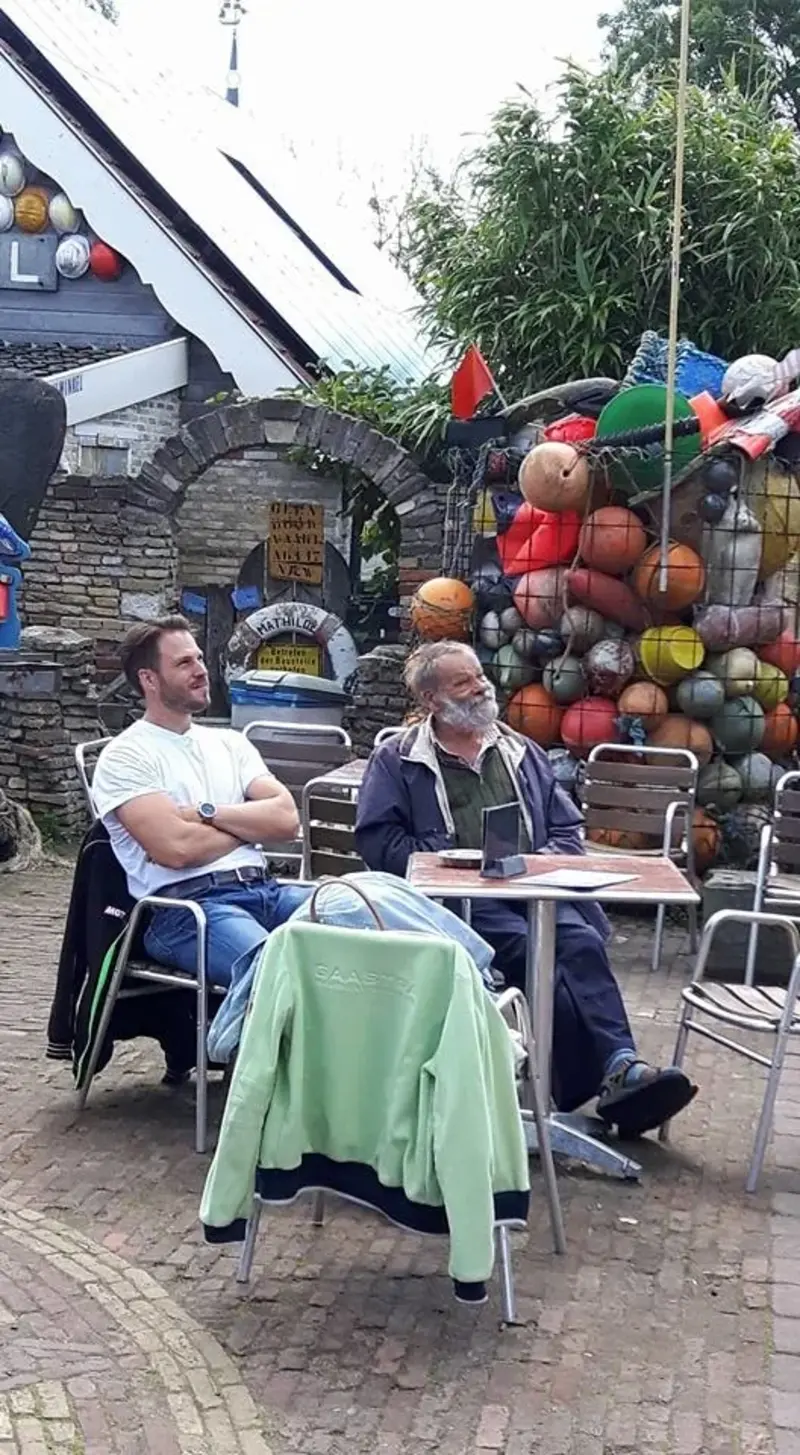
 Ready for a stay on Ameland? Book your spot at De Vlindertuin.